Small Scalar Binding
TL;DR - Just Tell Us What You Did
By sampling the verifiers random challenges from a set $S \subset \mathbb{F}$ of size roughly $\sqrt{|\mathbb{F}|}$, we speed up sum-check binding by 1.6x from baseline (where challenges are sampled over the whole field $\mathbb{F}$ -- the field over which polynomials are defined. )
NOTE: This now reduces the soundness error from $1/2^{254}$ to $1/2^{125}$, but this is not a concern as currently Jolt usess the bn256 curve to commit to polynomials, which offers 110 bits of security anyway.
Sum-Check Recap
We briefly recap the sum-check protocol1.
Let $g \in \Field[X_1, \ldots, X_m]$ be a polynomial over $\Field$ with the following structure. $$ g(X_1, \ldots, X_m) = \prod_{j=1}^d q_j(X_1, \ldots, X_m)$$ where all $q_j(X)$'s are multi-linear polynomials over $\Field$. We expand more below:
- Polynomial evaluation The prover computes the following univariate polynomial, using the following steps $$p_i(X_i) = \sum_{b_{i+1} \in {0,1}}\ldots\sum_{b_{m} \in {0,1}^{}}g(r_1, \ldots, r_{i-1}, X_i, b_{i+1}, b_m)$$ a. If $g$ has degree $d$, this requires computing $p_i(0), \ldots, p_i(d)$, then via standard lagrange interpolation, we're able to fully define $p_i(X)$. $$p_i(Z) = \prod_{j=1}^d \Bigg( \sum_{b_{i+1} \in {0,1}}\ldots\sum_{b_{m}} q_j\Big(r_1, \ldots, r_{i-1}, Z, b_{i+1}, \ldots, b_m\Big)\Bigg)$$ so to get $p_i(Z)$ we compute for all $j \in [d]$, $q_j(r_1, \ldots, r_{i-1}, Z, \vec{b})$ for $Z \in {0, \ldots, d}$ for all $\vec{b} \in {0, 1}^{m-i}$. As $q_j$ is multi-linear -- this can be computed by linear-interpolation.
As $d$ is a small constant number, computing the above value requires no multiplication operations. We can compute it via a running sum. See pseudocode below
/// Compute q_j(Z) = (1-Z) * q_j(0) + Z * q_j(1)
/// using only additions
/// when Z is a small integer.
    fn compute_q_j_running_sum(z: usize, q_at_0: JoltField, q_at_1: JoltField) -> JoltField {
        let diff = q_at_1 - q_at_0;

        // Compute Z * diff using repeated addition (running sum)
        let mut z_times_diff = JoltField::zero();
        for _ in 0..z {
            z_times_diff += diff;
        }

        q_at_0 + z_times_diff

    }
- Binding Phase Thee prover needs to binds the multi-linear polynomial $g$ to $r_i$, that is to say it computes a new multi-linear polynomial in $m-i$ variables $$g_i(X_{i+1}, \ldots, X_{m}) = g(r_1, \ldots, r_{i-1}, X_{i+1}, \ldots, X_{m})$$. This involves storing all evaluations of $g_i$ over the hyper cube ${0, 1}^{m-i}$, but unlike the above step $r_i$ is NOT guaranteed to be a small number. Therefore the running sum described in the pseudocode above is no good to use. We need to use actual multiplication here.
Now $q_j(r_1, \ldots, r_{i-1}, 1, b_{i+1}, \ldots, b_m) \in \Field$, and traditionally the set $S$ from which we sample $r_i$ is also equal to $\Field$. Therefore this step requires $2^{m-i}$ $\Field \times \Field$ multiplications in round $i$ -- a total of $2^m$ multiplications over $m$ rounds. It is well known that multiplication for $\Field$ elements is 1000x costlier than addition. So our hope is that we can choose $S$ cleverly such that this operation can be done faster. Note we cannot make $S$ too small, as this the soundness probability of any sumcheck protocol is given by $\frac{d}{|S|}$.
What we show
We show that there exists a set $S$ of size rouhgly $|\Field|^{1/2}$, which we call MontU128Challenge, in which $\Field \times r$ is 1.6x
faster than $\Field \times \Field$.
This in returns speeds up the binding phase of the sum-check protocol, which results in a 1.3x speedup per round of sum-check.
The Challenge Set $S$
Define the set
$$ S \subset \Field \text{where} S = { x \in \Field : \text{the least 2 significant digits of $x$ in Montgomery form are 0} } $$
Worked Out Example:
Prime Field $\Field = \mathbb{Z}_{13}$ with Montgomery Form. Montgomery parameter: $R = 16 = 2⁴$. Montgomery form of $x$ is given by $xR \mod 13$
| x | Montgomery Form (decimal) | Binary | Last 2 bits |
|---|---|---|---|
| 0 | 0 | 0000 | 00 ✓ |
| 1 | 3 | 0011 | 11 |
| 2 | 6 | 0110 | 10 |
| 3 | 9 | 1001 | 01 |
| 4 | 12 | 1100 | 00 ✓ |
| 5 | 2 | 0010 | 10 |
| 6 | 5 | 0101 | 01 |
| 7 | 8 | 1000 | 00 ✓ |
| 8 | 11 | 1011 | 11 |
| 9 | 1 | 0001 | 01 |
| 10 | 4 | 0100 | 00 ✓ |
| 11 | 7 | 0111 | 11 |
| 12 | 10 | 1010 | 10 |
$$S = {0, 4, 7, 10}$$
Note: $|S| = 4 \approx \sqrt{p}$, which makes sense since we're filtering by the last 2 bits.
The short answer to why we this set $S$ is nice, is that it saves us 10 multiplication instructions per field multiplication. We first briefly review the CIOS algorithm, which is currently used to multiply field elements.
CIOS Review
Let $n$ be the number of limbs used to represent field elements. Currently in Jolt, $n=4$. The width $w$ of each limb is 64 bits. Given $a \in \Field$ and $b\in S$ , let $\Mont{a} = aR \mod p, \Mont{b} = bR \mod p$ be the respective Montgomery representations.
Let $c = \Mont{a}\Mont{b}$ computed using textbook limb by limb multiplication. Now to get $\Mont{c}$ we need to compute $cR^{-1} = cr^{-n} = (ab)R \mod p$.
$c$ can be written as the following sum and we compute $cR^{-1}$ limb by limb by multiplying $r^{-1}$ $n$ times
Important Sub-Routine
Observe that $c_0r^{-1} \equiv (c_0 + mp)r^{-1} \mod p$, where $m$ such that $c_0 + mp \equiv 0 \mod r$. Solving for $m = -p^{-1}c_0 \equiv \mu c_0 \mod r$. Also as we are working modulo $r$, it suffices to use $m = \mu_{0}c_0$ discarding any carries, where $\mu_{0}$ is the least significant word of $\mu$.
Once we compute $mp$, and add this to $c$ to get $c^{(1)}$, this should clear the least significant digit based on how we picked $m$. See below
Repeat The Subroutine $n$ times
Now we can play the subroutine again with $c^{(1)}_1$ replacing the role of $c_0$, and the updated value of $m = \mu_0c_1^{(1)}$ (NOTE the same $\mu_0$ is always used)
In fact we play this game $n$ times
Total Multiplications
The total number of multiplications is $2n^2 + n$ which for $n=4$ is 36.
- $n^2$ multiplications to compute $c$.
- $n$ multiplications to compute to $m=\mu_i c_i^{(i)}$ in each round.
- $n$ multiplications to compute $mp$ per round which totals $n^2$ multiplications.
Next we illustrate how sampling $\Mont{b} \samples S$ saves us multiplications.
Firstly when 2 digits are 0 we we only need $n \times (n-2)$ multiplications, which allows us to save 8 multiplications when $n=4$.
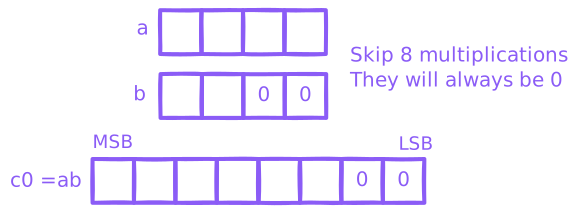
Remember the reduction phase is all about 0'ing out the least significant digit. If it's already 0 we do not need to compute $m_0 p$ and $m_1p$ anymore.
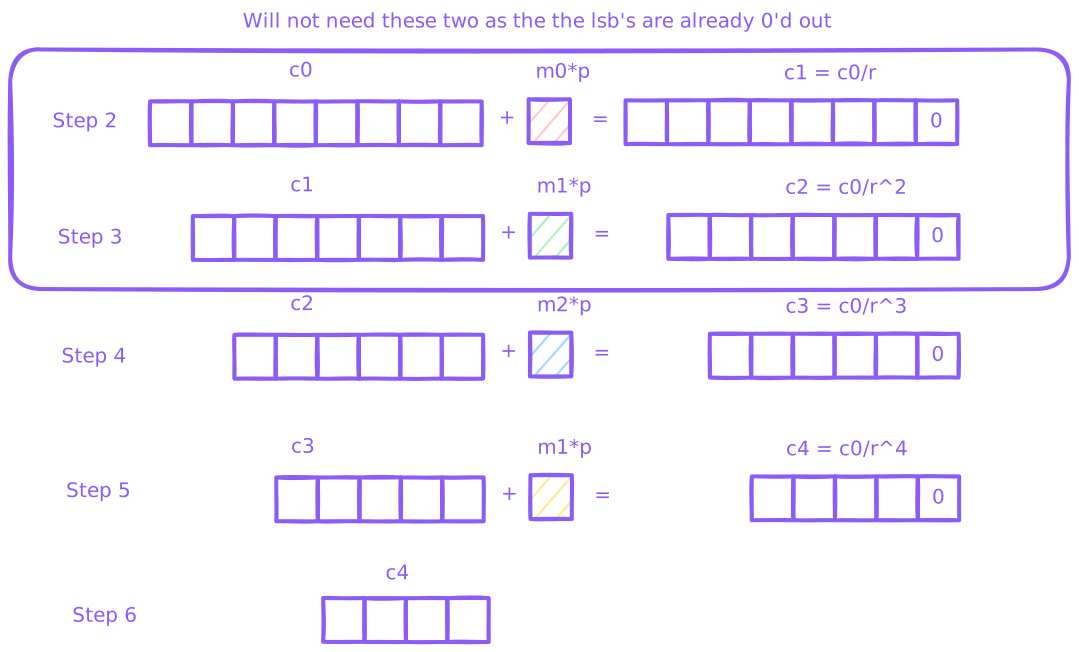
This saves us $8 + 2 + 8= 20$ multiplications, which leaves with only $16$ multiplications
If multiplications were the only thing that cost us CPU cycles we should see roughly 2x speedup. However, additions and bit shifts -- although significantly cheaper, are not free. Thus, a reasonable expectation would be to see 1.6-1.8x speedup.
So we compute $(a-b)\times c$, where $a,b\in\Field$ and $c\in S$, 100 times and measure how long it takes.
- $S = \Field$
- $S$ is 2 least significant digits 0'd out.
cargo bench -p jolt-core --bench challenge_mult_performance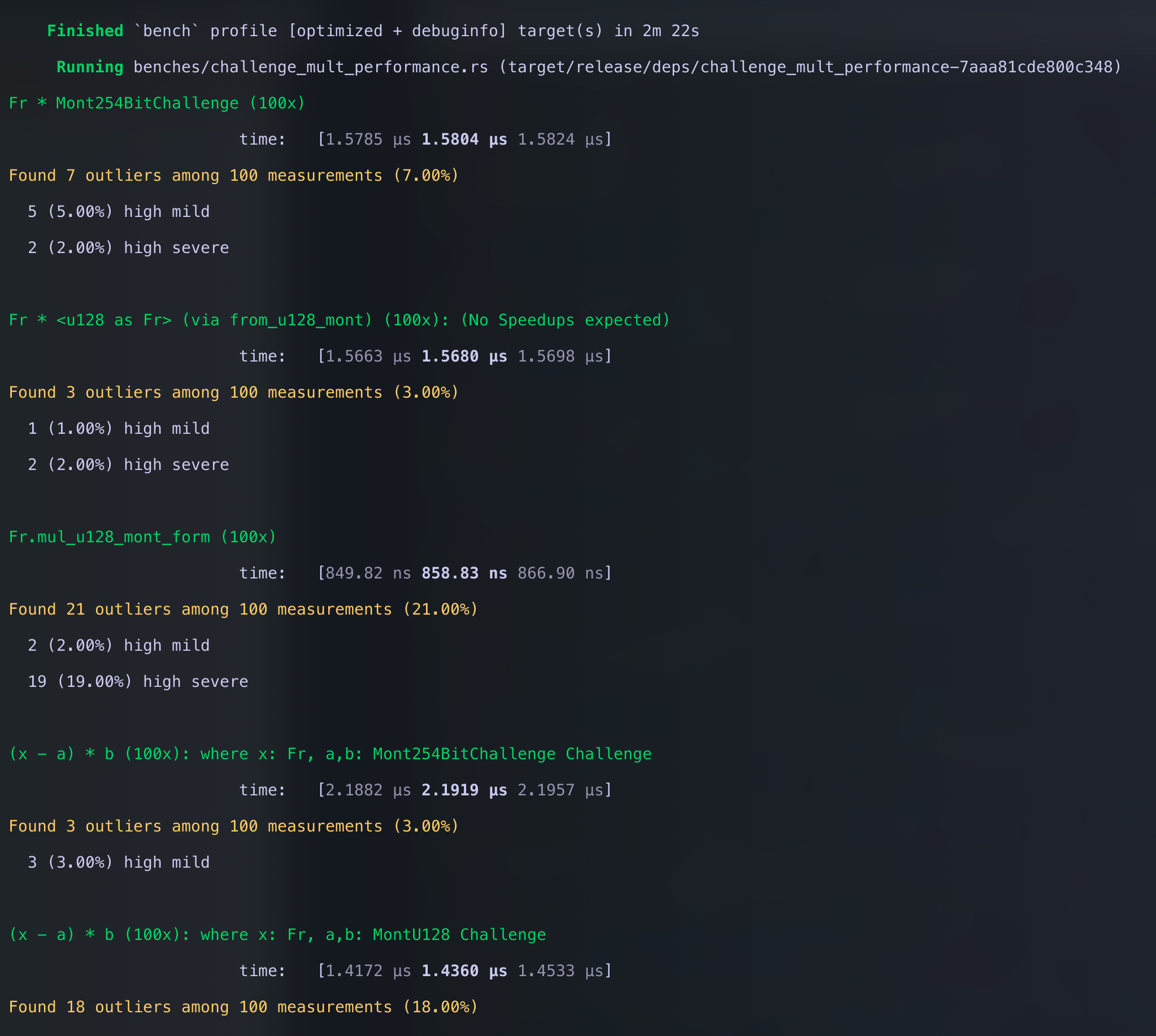
Next we show that this improved multiplication does indeed speed up polynomial binding
cargo bench -p jolt-core --bench binding
cargo bench -p jolt-core --bench binding --features challenge-254-bit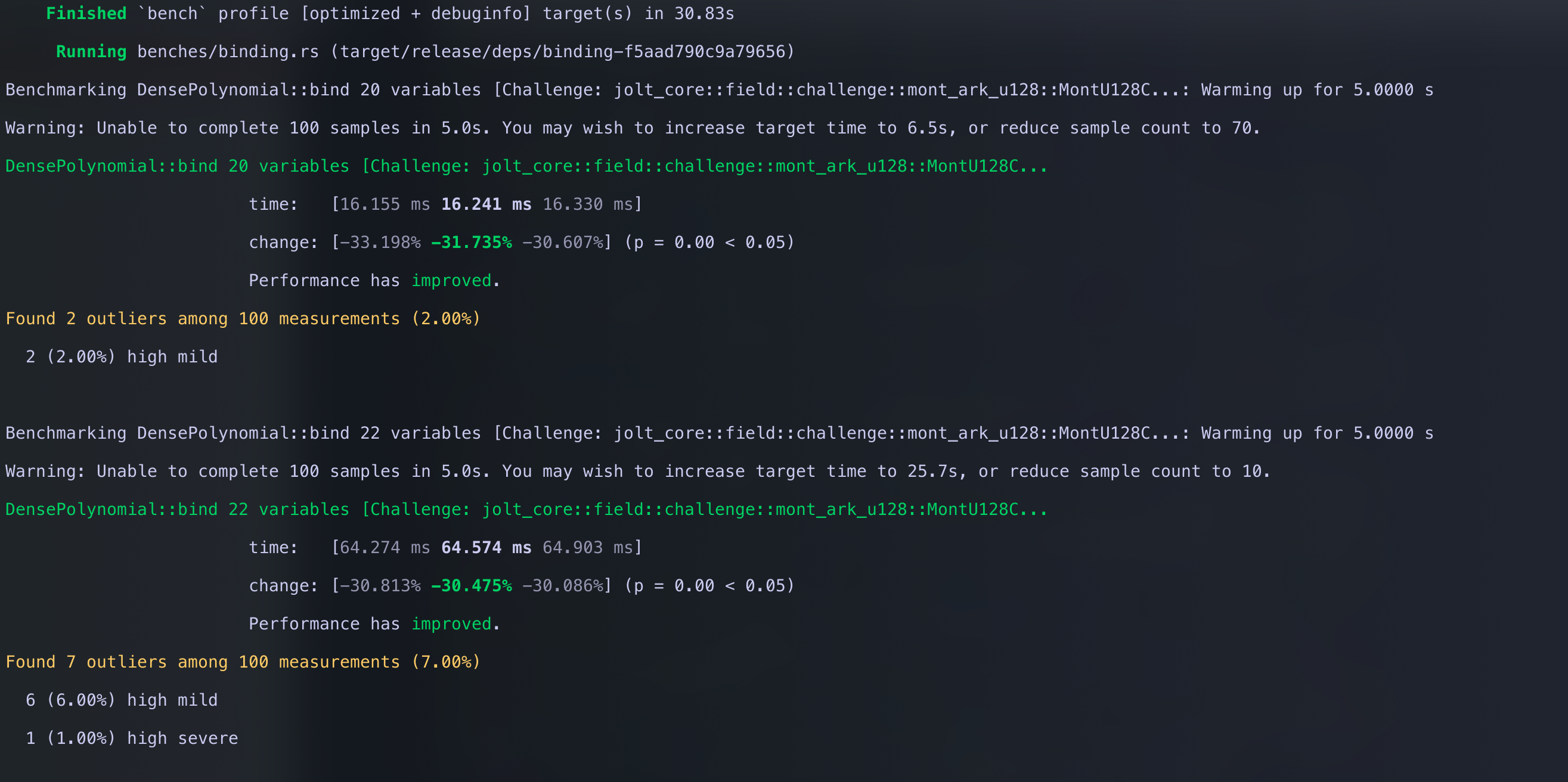 Comparing it against the baseline
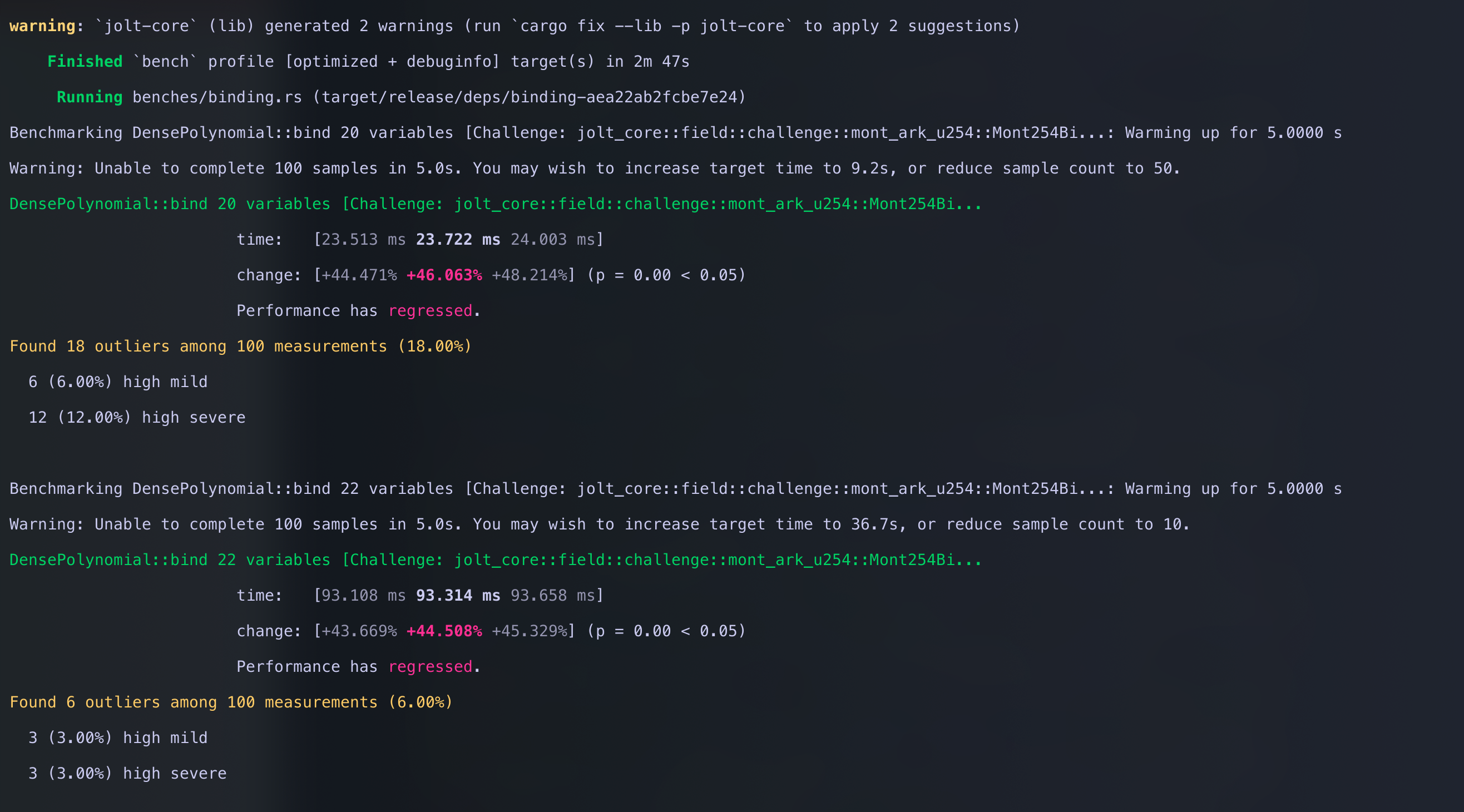
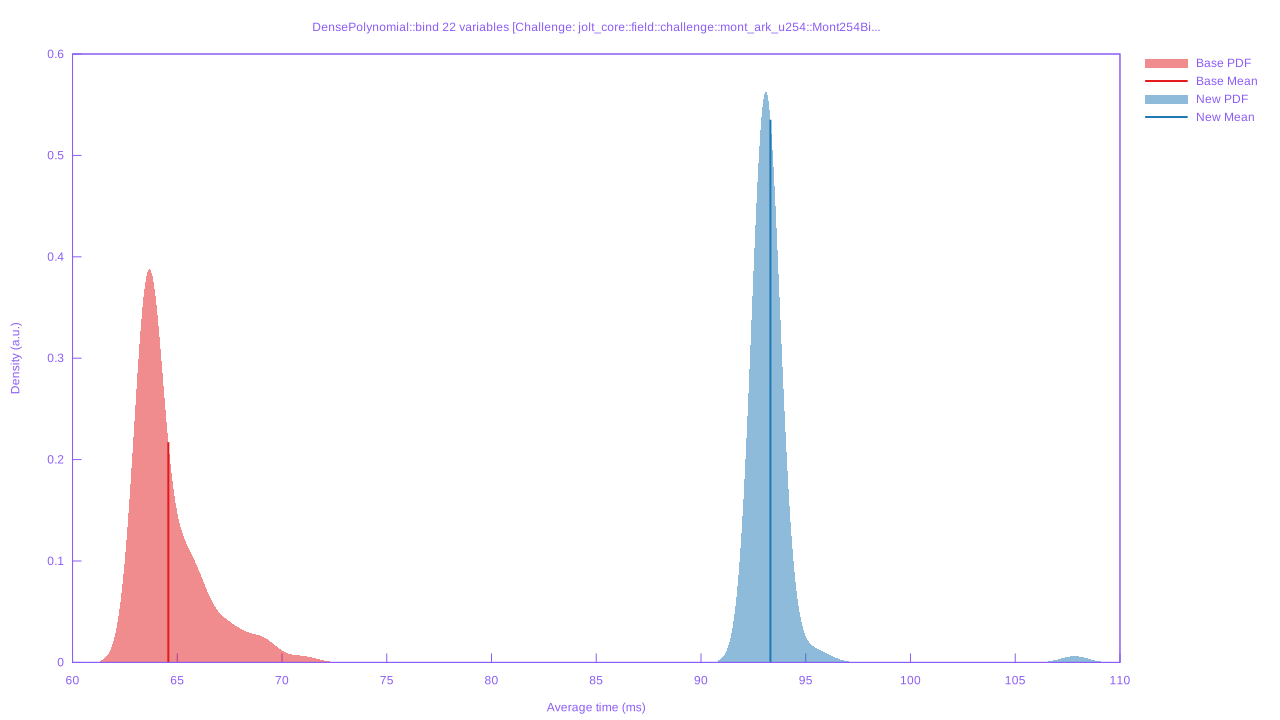
Shown below is the diff from bench with the red pdf representing our fast multiplication.
Some Implementation Details
we use $256$ bits to represent big integers and our challenge and the modulus for ark-bn256 uses $254$ bits. Thus, if sampled a 2 limbed $128$ bit integer $x$ and used that as the challenge as is x = [x_1, x_0, 0, 0] we are not guaranteed that $x < p$ which the CIOS algorithm assumes.
we use $256$ bits to represent big integers and our challenge and the modulus for ark-bn254 uses $254$ bits. Thus, if sampled a 2 limbed $128$ bit integer $x$ and used that as the challenge as is x = [x_1, x_0, 0, 0] we are not guaranteed that $x < p$ which the CIOS algorithm assumes.
So we clear the first 3 bits of $x$ to ensure that $x$ is ALWAYS less than $p$.
impl<F: JoltField> MontU128Challenge<F> {
pub fn new(value: u128) -> Self {
    // MontU128 can always be represented by 125 bits.
    // This guarantees that the big integer is never greater than the
    // bn254 modulus
    let val_masked = value & (u128::MAX >> 3);
    let low = val_masked as u64;
    let high = (val_masked >> 64) as u64;
    Self {
        value: [0, 0, low, high],
        _marker: PhantomData,
    }
}

pub fn value(&self) -> [u64; 4] {
    self.value
}

pub fn random<R: Rng + ?Sized>(rng: &mut R) -> Self {
		Self::from(rng.gen::<u128>())
	}
}
Footnotes and References
In practice, these protocols are implemented non-interactively using the Fiat-Shamir transform. The verifiers work is restricted to sampling random values.
We have to conditionally subtract from $p$ to get the actual right answer, but this operation is common to both the baseline and our optimisation, so we do not focus on this.
There are optimisations by [?] that improve on this, but the optimisations discussed in this note still apply, so for the sake of simplicity, we describe the Sum-check protocol in its simplest form.