Graham And Pollock (1971)
Notation: $[n] = \{1, 2, \ldots, n \}$
Main Result#
The result is due to R. L. Graham and H. O. Pollak, “On the Addressing Problem for Loop Switching” (1971).
For $n = 4$, we get this picture.
Note that each sub-graph is bi-partite, and complete.
No edge is re-used.
So we have decomposed $K_4$ into edge-disjoint bi-partite cliques.
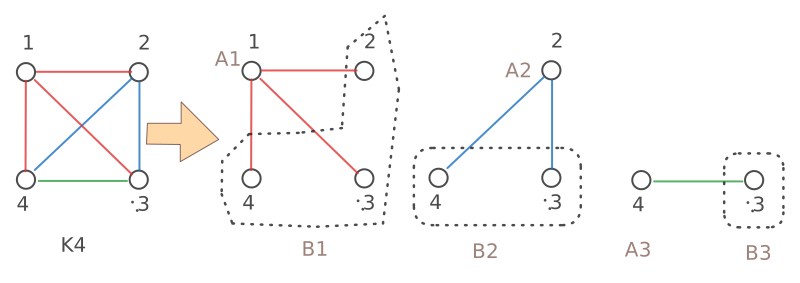
The general algorithm is the following, for all $i \in [n]$,
$$A_i = \{i\} \qquad B_i = \{i+1, \ldots, n\}$$ Starting at $i=1$, incrementally remove all edges incident on vertices in $A_i$ from $K_n$ and add them to $A_i \cup B_i$. Then continue the process from what is left in the edge set.